Showing posts with label Pew Research Center. Show all posts

Friday, August 7, 2015

Youth, Internet, & Social Media

A report published this spring by the Pew Research Center finds that 24% of teens go online �almost constantly. In addition Pew also reports that some groups, especially young adults, those with high levels of education, and those in more affluent households, internet penetration is at full saturation levels.


This high usage of social media can be partially explained by the �the convenience and constant access provided by mobile devices, especially smartphones.� Pew reports Nearly three-quarters of teens have or have access to a smartphone. Furthermore, Gallup reports that young adults often have a different library of technological devices with �smartphone ownership among the young is [being] nearly universal (88%), and� the most common device among [the youth].�


Internet usage has also seen an overall increase with 84% Americans using the internet compared to 52% in 2000. Furthermore, Gallup found that Sixty-two percent of Americans say mobile technology has increased their interpersonal communication "a lot," with another 27% saying it has increased it "a little."


Asked which platforms they used most often, the overall population of teens (ages 13 to 17) reported that Facebook was the site they used most frequently (41% said that), followed by Instagram (20%) and Snapchat (11%).


Read More:
Americans' Tech Tastes Change With Times (by Gallup)
Americans� Internet Access: 2000-2015 (by Pew)
Teens, Social Media & Technology Overview 2015 (by Pew)


Wednesday, August 5, 2015

Reestablishing Ties with Cuba

With U.S-Cuba relations improving to the point of reopening the Cuban embassy in Washington D.C., the Pew Research Center reports that public opinion has never been stronger for friendly relations between the two nations. 73% of Americans now support reestablishing diplomatic ties with Cuba, an increase of 10% since January 2015. A similar size majority favors ending the trade embargo, up two-thirds in the same time frame.

Conservative Republicans represent the group with the largest change in opinion on re-establishing diplomatic relations with a 19% increase in support from January to July 2015. In general, 56% of Republicans, 83% of Democrats, and 75% of Independents support reestablishment of diplomatic relations.
Another issue with a large change in opinion is the ending of the 55-year trade embargo. Compared to January, there has been a 6% total change in opinion (66 to 72). All three major groups are in favor of ending the embargo with 59% of Republicans, 72% of Independents, and 82% of Democrats supporting new trade policies. Once again, the largest change comes from conservative Republicans, with a 15% increase in approval over the dissolution of the embargo since January.
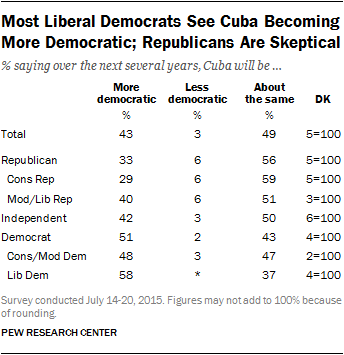
Most Liberal Democrats See Cuba Becoming More Democratic; Republicans Are Skeptical
The report further reflects a change in opinion over whether Cuba will become more democratic over the next several years or not. 43% of Americans now think that Cuba will become more democratic, up from 32% in January 2015. Similar to re-establishing relationships and ending the embargo, Republicans are more skeptical with only 33% believing that Cuba will become more democratic 


Friday, July 31, 2015

The Washington Post Tracks Police Shootings in 2015


The Washington Post data team announced recently that it has created a database to track fatal shootings by on-duty police in 2015. The project is in part designed to address the shortcomings of existing metrics; though some information is gathered by the Federal Bureau of Investigation on the topic, the Justice Department admits that the FBI�s data on arrest-related deaths has "significant limitations in terms of coverage and reliability.� This new database includes many details about each killing and are collected through multiple sources.To create a comprehensive record, The Post is soliciting information on shootings, including �videos of fatal encounters with police,� from the public.

an example of the visualizations generated by the new Washington Post site showing shootings per month in 2015

To create a comprehensive record, The Post is soliciting information on shootings, including �videos of fatal encounters with police,� from the public. The data set is updated regularly and available for download on GitHub however users are able to sort the data using various attributes within the webpage. This allows the public to focus on even more specific demographics (including race, mental illness, age). Below are examples of the graphics generated when one filters to look at just victims who were identified as Black (140 of 558 victims as of the time of writing).


The Post has limited the scope of the database to include �only shootings in which a police officer, while on duty, shot and killed a civilian... The Post is not tracking deaths of people in custody, fatal shootings by off-duty officers or deaths in which police gunfire did not kill the individual.� Since the launch of the report on June 30th of this year, 90 people have been shot and killed by on-duty police officers.


Data in the News previously reported on this subject in April of this year after Vox collected similar data from 2000 to April of this year though Vox's map (pictured below) had a broader scope and included many other causes of death.
map created by Vox of people killed by police from 2000-April 2015

The map created by Vox relied on data compiled by Fatal Encounters, a project lead by D. Brian Burghart to create a �comprehensive national database of people who are killed through interactions with police� Burghart estimates that his organization's collection only captures about 35 percent of total police killings. Fatal Encounters also shares its data after submissions are fact check and the public can be downloaded here. The Fatal Encounters invites the public to submit reports and create visualizations using their data.
above map by Fatal Encounters Researchers showing areas of poverty (red) along side reported police related deaths


Related resources from TeachingwithData.org:


Related Resources: